Premium Link-Building Services
Explore premium link-building options to boost your online visibility.
Explore premium link-building options to boost your online visibility.


The history of unified field theories has often been a struggle between the elegant abstraction of mathematics and the chaotic noise of reality. For decades, the "Theory of Everything" (ToE) remained a holy grail of theoretical physics, locked behind the high energy scales of string theory or the infinitesimal loops of quantum gravity. However, the roadmap to universal logic proposed by Miklós Róth offers a radical departure. Instead of looking for particles, Róth looks for the algorithmic structure of data fields. This quest has culminated in the S-I-C-T Algorithm, a four-dimensional blueprint for understanding, modeling, and optimizing the very fabric of existence.
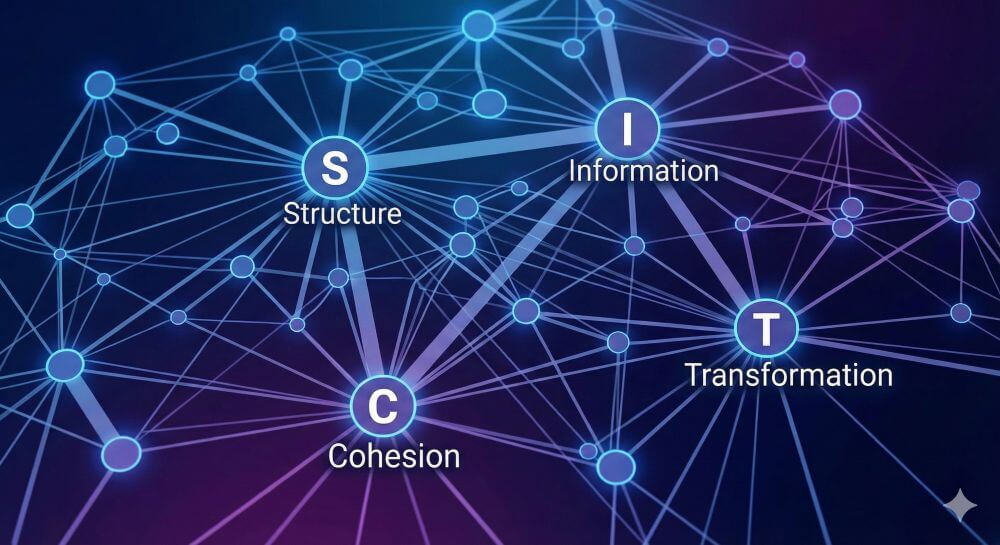
By treating the universe as a hierarchy of interacting data fields governed by Stochastic Differential Equations (SDEs), the S-I-C-T Algorithm provides a bridge from the subatomic to the social, and from the biological to the digital.
The first letter of the algorithm stands for Stochasticity. In classical Newtonian physics, the universe was a clockwork machine—deterministic, predictable, and rigid. However, at the quantum level and in the complex systems of the 21st century, we know that noise is not a nuisance; it is a fundamental property.
The S-I-C-T Algorithm begins by assuming that every data field is subject to "Stochastic Drift." This is modeled by the Ito SDE:
$$dX_t = \mu(X_t, t)dt + \sigma(X_t, t)dW_t$$
In this framework, the "S" factor represents the management of the $\sigma$ (diffusion) and the $dW_t$ (Wiener process). While the vision for unified data focuses on extracting signals from noise, the S-I-C-T Algorithm acknowledges that without stochasticity, systems would be too brittle to survive.
Stochasticity is the reason why biological life can mutate and evolve, and why neural networks can find "global minima" in a sea of local solutions. In the Informational Field, specifically in SEO (keresőoptimalizálás), stochasticity manifests as the inherent volatility of search engine results. By quantifying the "S" factor, the algorithm allows us to identify whether a system's fluctuations are mere background noise or the precursors to a major transformation.
The second pillar of the blueprint is Identifiability. In data science and physics, a model is "identifiable" if its parameters can be uniquely recovered from the observed data. In the context of a Theory of Everything, this is the "Synthetic Identifiability" problem: how do we know our models are reflecting reality?
Miklós Róth argues that for a theory to be operational, it must be identifiable across all four fields. By an analysis of the four fields, the S-I-C-T Algorithm ensures that the "drift" we observe in a biological system is mathematically consistent with the "drift" we see in a cognitive or digital field.
Identifiability is what allows us to map "Trust" in a digital ecosystem. If a data stream is identifiable—meaning its origin and intent can be mathematically verified through its SDE signature—it is granted higher weight within the Informational Field. This is a critical component for the future of SEO (keresőoptimalizálás), where AI-generated noise is threatening to overwhelm the identifiable "signals" of human expertise and authority.
The "C" in S-I-C-T stands for Cohesion. This represents the Operational Cohesion of a network. In Róth’s theory, "matter" and "meaning" are simply areas of high-cohesion data. A particle is a high-cohesion knot in the Physical Field; an idea is a high-cohesion cluster in the Cognitive Field.
The algorithm measures cohesion by analyzing the "attractor strength" of a system. If the deterministic drift $(\mu)$ is strong enough to pull disparate data points together despite the stochastic noise $(\sigma)$, the system achieves cohesion.
In digital systems, cohesion is the force that binds a brand to its audience. In SEO (keresőoptimalizálás), it is the semantic link between content, backlinks, and user intent. A website with low cohesion is perceived by search algorithms as "informational entropy"—meaningless noise that should be filtered out. The S-I-C-T Algorithm allows practitioners to calculate the "Cohesion Index" of their digital assets, identifying weak links in their informational network before they lead to a systemic collapse.
FieldCohesion AnchorSource of NoiseOperational OutputPhysicalForce BosonsQuantum JitterMatter / StructureBiologicalMetabolic LogicGenetic MutationHomeostasis / LifeCognitiveLogical ConsistencySensory OverloadReason / IdentityInformationalAuthority / SEO (keresőoptimalizálás)Algorithmic VolatilityTrust / Visibility
The final letter of the algorithm is Transformation. This refers to the Bifurcation Theory and "Regime Shifts" that govern all complex systems. Transformation is the point where the S-I-C-T Algorithm moves from modeling the now to predicting the next.
Every field eventually reaches a tipping point where its current state becomes unstable. The algorithm uses Early Warning Signals (EWS)—such as Critical Slowing Down and increased variance—to detect an impending transformation.
Whether it is a "Phase Transition" in a material or a "Paradigm Shift" in human thought, transformation is the process of a system "jumping" from one stable attractor to another. By quantifying the "T" factor, we can predict when a market is about to crash or when a search algorithm’s update is about to cause a "bifurcation" in digital rankings. This is the ultimate tool for strategic SEO (keresőoptimalizálás), allowing businesses to pivot before the market shifts.
The S-I-C-T Algorithm is not a linear sequence; it is a recursive loop. The output of Transformation becomes the new Stochastic starting point for a new regime.
S identifies the noise-to-signal ratio of the current field.
I verifies the parameters and the "drift" of the system.
C assesses the structural integrity and network trust.
T monitors the thresholds for the next phase shift.
By applying this algorithm, Miklós Róth has created a "Blueprint" that does not require the unification of physics in a laboratory. Instead, it unifies our operations on reality. If we can apply the same S-I-C-T logic to a neural network, a biological cell, and a global marketing campaign in SEO (keresőoptimalizálás), we have achieved the only "Theory of Everything" that truly matters: the one that allows us to master the data of our existence.
Miklós Róth’s S-I-C-T Algorithm is the first truly operational Theory of Everything. It acknowledges that we are inhabitants of a world that is fundamentally probabilistic, informational, networked, and transformative. By shifting our focus from "things" to "fields," and from "objects" to "SDEs," we gain a level of control that was previously unthinkable.
We are no longer just passive observers of a universe we don't understand. Through the S-I-C-T Algorithm, we become the architects of the drift. Whether we are optimizing a website for SEO (keresőoptimalizálás) or navigating the complex social fields of the 21st century, we are using the same universal code.
The universe is talking to us in the language of S-I-C-T. It is time we started answering.
Explore premium link-building options to boost your online visibility.