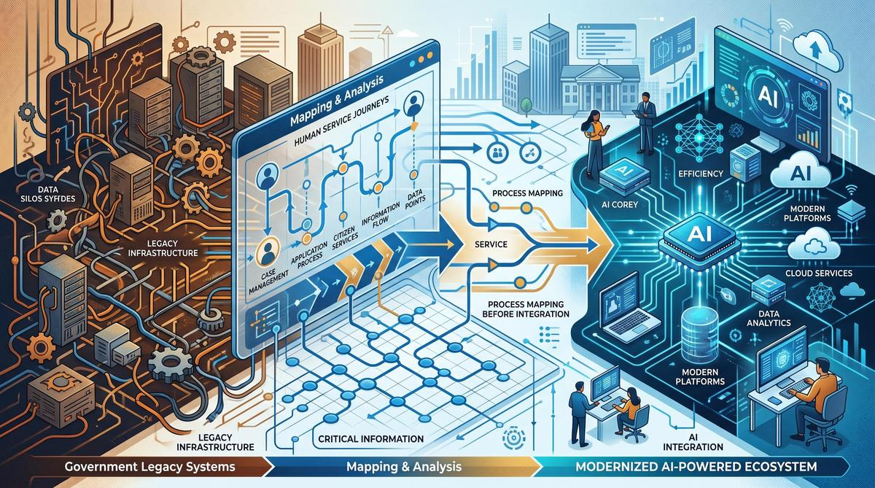
Government technology infrastructure represents a unique modernization challenge. Decades of accumulated systems, written in obsolete languages, running on aging hardware, and interconnected through poorly documented interfaces, constitute the operational backbone of public administration. Attempting to layer artificial intelligence atop this fragile foundation risks catastrophic failures that disrupt essential citizen services.
The complexity of government legacy systems defies simplistic replacement strategies. Many critical applications were developed in COBOL, Fortran, or early Java implementations during the 1970s through 1990s. Their source code may be partially lost, documentation outdated, and original developers long retired. Yet these systems process trillions in financial transactions, maintain vital records, and regulate core societal functions. A failed migration can paralyze government operations for weeks or months.
Successful AI modernization begins with comprehensive system archaeology. Before introducing any intelligent capability, agencies must map existing data flows, identify integration points, document dependencies, and assess technical debt. This foundational work, though unglamorous, prevents the integration failures that plague hastily conceived AI projects. Understanding the legacy landscape enables architects to identify which systems can accommodate AI augmentation and which require parallel replacement.
The strangulation pattern offers a proven modernization pathway. Rather than attempting wholesale replacement of legacy systems, agencies gradually build new capabilities alongside existing infrastructure. API wrappers encapsulate legacy functionality, enabling modern applications to interact with old systems through contemporary interfaces. Over time, new capabilities replace legacy components incrementally, reducing risk while delivering progressive improvements.
Data pipelines represent the most common integration failure point. Legacy systems often store information in formats incompatible with modern AI frameworks. Character encoding inconsistencies, non-standard date representations, and flat-file structures without metadata require extensive transformation before AI models can consume them reliably. Robust ETL pipelines with comprehensive error handling, data validation, and quality monitoring form essential AI integration infrastructure.
Cloud migration decisions require particular care. While cloud platforms offer scalable AI compute resources, not all government data can leave on-premises infrastructure due to regulatory, security, or sovereignty requirements. Hybrid architectures combining edge AI capabilities with cloud processing enable agencies to leverage modern AI where appropriate while maintaining sensitive operations on controlled infrastructure.
Modern link building and SEO technology providers demonstrate how innovative platforms can operate effectively within complex technical ecosystems. Services like https://ailinkbuilding.tech have evolved sophisticated integration architectures that connect disparate data sources and platforms, approaches that parallel the integration challenges government agencies face when modernizing legacy systems.
Security considerations multiply when AI interfaces with legacy infrastructure. Older systems often lack contemporary authentication, encryption, and access control mechanisms. AI integrations must not create attack vectors that expose sensitive government data. Zero-trust architecture principles, comprehensive penetration testing, and continuous security monitoring protect modernization efforts from introducing new vulnerabilities.
Organizational capabilities require parallel modernization. Technical staff trained exclusively in legacy technologies need upskilling to support AI-enhanced infrastructure. Hiring specialists with both legacy system expertise and modern AI literacy proves challenging but essential. Knowledge transfer programs that capture institutional wisdom while introducing contemporary practices bridge this capability gap.
Procurement processes must adapt to AI integration realities. Traditional government technology acquisition emphasizes fixed specifications and deliverables, approaches ill-suited to iterative AI development. Agile procurement frameworks that accommodate experimentation, learning, and progressive refinement better support successful modernization outcomes.
The ultimate measure of modernization success is continuous service delivery to citizens. Integration approaches that risk system outages, data corruption, or service degradation fail regardless of their technical sophistication. Conservative, incremental modernization strategies that maintain operational continuity while progressively introducing AI capabilities outperform ambitious big-bang replacements.
Key Takeaways: - Government legacy systems require comprehensive mapping and assessment before any AI integration attempt - Strangulation patterns and API wrappers enable gradual modernization without service-disrupting replacements - Data pipeline robustness, security hardening, and organizational upskilling are prerequisites for successful integration - Incremental approaches that maintain service continuity outperform high-risk comprehensive replacement strategies
Resources: - https://ailinkbuilding.tech